

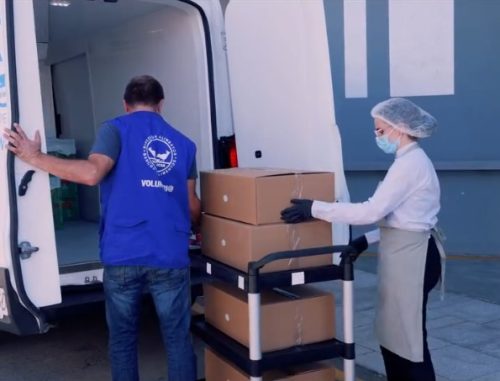
The Paradox of Waste in Times of Need
We live in an era of deep contradictions. Despite technological advances, logistical progress, and abundant resources in many sectors, a significant portion of the population still lacks guaranteed access to adequate food. In Spain, it is estimated that around 10% of the population experiences food insecurity, a situation that directly affects health, dignity, and life opportunities.
At the same time, the food supply chain generates tons of surplus food daily—perfectly suitable for human consumption—that goes unused. According to the Ministry of Agriculture, Fisheries, and Food, about one-third of the food produced in Spain is wasted, with enormous ethical and environmental costs: every kilo wasted also means wasted water, energy, and emissions.
Faced with this reality, redistributing surplus food emerges as an urgent solution. But it is not an easy path: it involves challenges of food safety, traceability, delivery times, logistical coordination, health regulations, and, above all, trust among very different actors.
Technology Serving the Common Good
In this complex scenario comes the proposal from Naria, a technological platform developed in Castellón (Spain) that channels surplus food to social organizations and food banks through a blockchain-based system. Its differential value lies in something simple but critical: complete and verifiable traceability of every donation.
Blockchain is a decentralized, immutable digital ledger, meaning all parties involved—from donor to recipient—can access the same information in real time, with the assurance that it has not been altered or manipulated. This approach provides transparency, reliability, and efficiency, removing traditional bottlenecks associated with bureaucracy, health concerns, or lack of coordination. Naria’s mission is not only to reduce waste but also to digitalize the social aid sector and reconfigure the food system with justice and efficiency.
When Commitment Finds a Way
“When we thought about digitalizing food aid, we imagined supermarkets, logistics platforms, or social canteens. What was less clear was whether the catering world—so tied to immediacy, impeccable presentation, and the guest experience—could join this transformation. Gourmet Catering & Eventos was, for us, the first answer to that question,” says Nacho Latre, Naria’s communications director.
“Their decision to implement our system in 2023 opened the door to an unknown and highly challenging territory. Catering does not operate like traditional food distribution: there are no long-term forecasts or margin for error. Everything moves in minutes, with strict protocols and a pace that allows no distractions. It was legitimate to ask: could a traceability and donation model fit into such a demanding environment?”
“Gourmet Catering & Eventos proved that it could, with dedication and responsibility,” Latre continues. “With over 2,500 services annually and 360,000 diners, it was the perfect example to test how far our technology could go without interfering with operations. What we truly learned from our collaboration is that impact is not measured solely in technology or tons rescued, but in what happens afterward—when food reaches the hands of those who need it. The real value of each donated portion lies in the assurance that food reaches good hands, in the ability of social organizations to serve more people without overwhelming their resources, in the silent network of trust built between producers, distributors, and aid organizations.”
The Real Value of Each Portion
Every recovered food item is a small link connecting the world of gastronomy with social aid, showing that excellence does not end when the last plate is cleared, but when surplus finds a new purpose.
In 2025, thanks to this collaboration, 4,378 kg of food were donated, resulting in 10,424 meals served and 10,945 kg of CO₂ avoided. Since the project began in 2023, 11,301 kg of food have been recovered, distributed in 26,908 meals, avoiding 28,253 kg of CO₂. Most of these meals (97.4%) reached the Valencia Food Bank, while the Segura Food Bank (2.5%) and Fundación Ayuda a una Familia (0.1%) joined the donation network in 2025, demonstrating the tangible and growing impact of the collaboration.
This experience confirms that combining commitment, technology, and social responsibility can create a lasting, meaningful effect in the lives of those who need it most.
The MagNuS Project and the Documentary “València, the City that Feeds Sustainable Change”
In addition to the donation system launched in 2023, Gourmet Catering & Eventos actively participates in the MagNuS project, an initiative developed alongside CEMAS, the Valencia Conference Centre, Fundació Lluís Alcanyís – Universitat de València, the Valencian Institute of Agrarian Research (IVIA), and Naria, which aims to measure, reduce, and raise awareness of food waste in MICE (Meetings, Incentives, Conferences & Exhibitions) events.
This project analyzes food surplus at conferences and events held at the Valencia Conference Centre, identifying causes and promoting best practices that allow for more sustainable and responsible organization.
Within this framework, the documentary “València, the City that Feeds a Sustainable Change” was presented. This audiovisual piece highlights the city’s role in transforming food systems and combating waste. The documentary emphasizes how collaboration between public authorities, companies, and research centers is key to advancing a fairer and more efficient food model.
You can watch the documentary here: